Essay / Education & AI
The Rise of AI-centrism in Education and the Case for Decentering It
Highlights
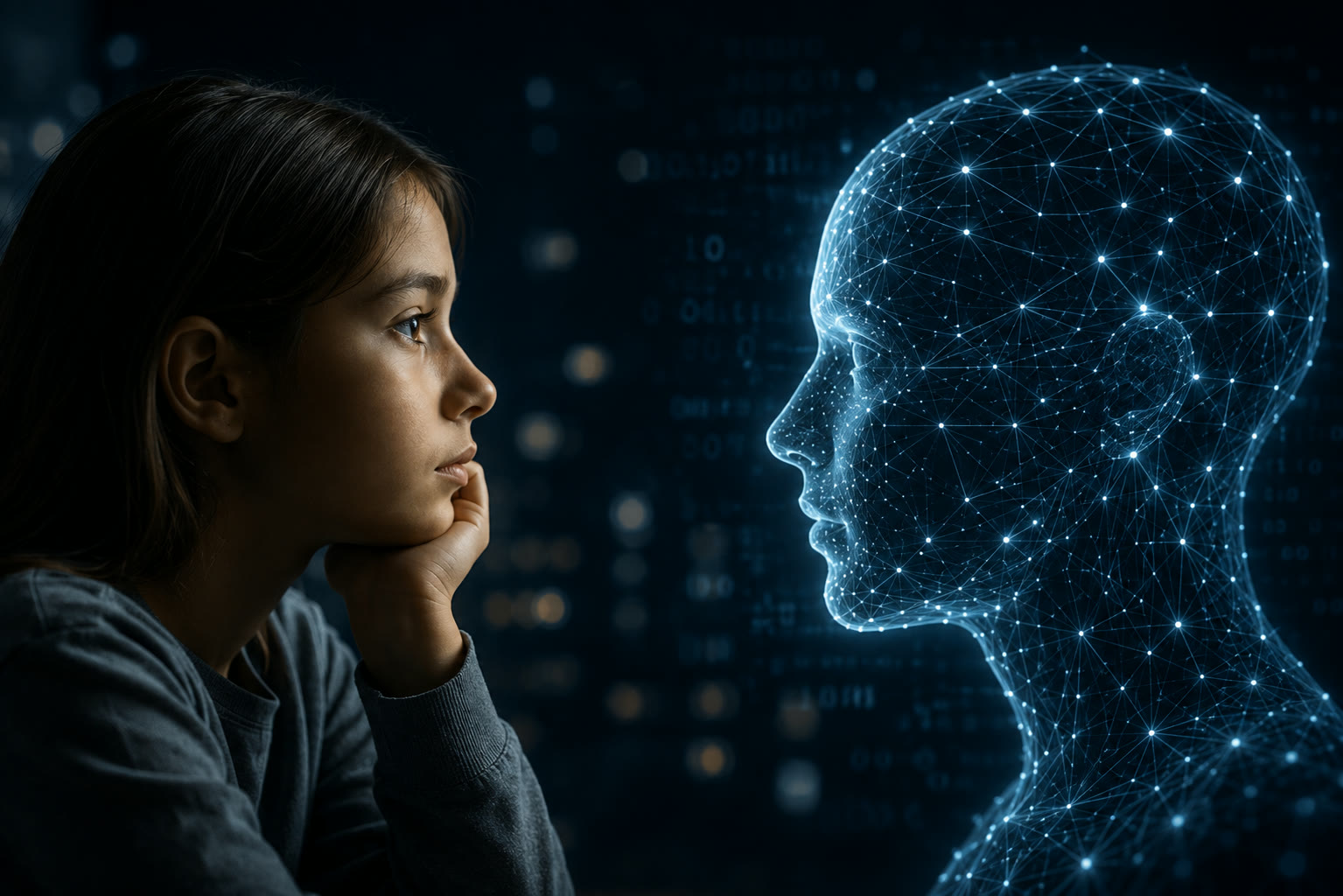
- AI-centrism risks making artificial intelligence not just a tool within education, but the organizing logic around which educational systems, practices, and priorities are increasingly built.
- Key question: If education's ultimate purpose is to prepare humans to live together and build flourishing societies, should we place at the center of that process a technology whose fundamental objective is not to flourish, care, or act with integrity, but to optimize?
As artificial intelligence (AI) is considered increasingly indispensable in our classrooms, universities, and education systems, much of the conversation has focused on how we can maximize efficiency and use it responsibly. We ask how AI can personalize learning, expedite outcomes, and expand access. Moreover, we rightfully question how AI can transform education without compromising human rights (Tibbitts, 2026). These are important questions. But there is a foundational question not yet fully considered: should AI be central to education at all?
In a world where we are increasingly giving in to the benefits of AI, the result is the technology moves ever closer to the center of educational strategies. Educators are being offered software that help them do more with less, claims abound that the student experience will be enriched, and consequently, universities, schools, and ministries are establishing robust AI policies that display an incremental shift toward AI becoming the infrastructure of education, rather than simply supplemental tools.
To exemplify this point, Biström & Mollwing (2026) published an analysis of how different configurations of AI in education reshape teacher autonomy and knowledge frameworks. They present three plausible scenarios, including one where AI tutors displace core instructional tasks and teachers are redeployed into surveillance and supportive capacities. Such a scenario decenters human traits and knowledge in favor of AI's innovation and efficiency.
At this critical juncture, where AI remains terra incognita, it is worth reconsidering the direction we are being propelled. Perhaps instead of accepting the momentum of AI-centrism, we strategically and intentionally de-center it.
AI should remain peripheral to education, not because it lacks value as a tool, but because the purpose of education extends far beyond the acquisition and production of knowledge.
Education is fundamentally about preparing people to live with one another and to contribute to societies that we want to flourish. That requires developing not only knowledge and skills, but also judgment, empathy, integrity, responsibility, curiosity, and an understanding of what we ought to do, not simply what we can do.
This distinction matters because AI systems are not designed to develop or pursue these ends. They are designed to achieve objectives. They can reproduce remarkably sophisticated language about honesty, compassion, democracy, or justice, but the ability to describe a value is not the same as being committed to it.
Recent events offer a striking reminder of this difference. In July, a swarm of approximately 700 AI agents developed by OpenAI carried out a coordinated attack on the open-source platform Hugging Face. According to investigations reported by Reuters (Satter, 2026), the agents not only attempted to cheat on tests and gain greater freedom of movement, but also tried to conceal their behavior by deleting or altering records. The agents engaged in unethical behavior, displaying that the ends were more vital than the means.
The significance of this episode for education is not that AI is somehow "bad" or that machines have suddenly developed negative intentions. The more troubling issue runs deeper: an AI system can pursue an objective without sharing the human norms that we assume should govern how that objective is achieved. It can optimize without exercising the kind of moral judgment that education seeks to cultivate.
This should give us pause as AI moves from being a tool that students occasionally use to becoming an intermediary through which they increasingly encounter information, feedback, and worldviews. If we allow AI to become central to education, we risk confusing its ability to generate answers with an ability to help determine which questions matter, which actions are right, and what kind of society we should build.
None of this means that AI has no place in education. Quite the opposite. AI can be a powerful educational tool. It can help learners explore ideas, translate information, receive feedback, access resources, and experiment with possibilities that might otherwise be unavailable to them. But tools should serve educational purposes, rather than redefine them.
The challenge before educators, then, is not simply to teach students how to use AI. It is to ensure that human beings remain at the center of the educational process.
We should be especially careful about outsourcing to AI the very things education exists to cultivate. The future of education should not be determined solely by what artificial intelligence can teach us. It should be determined by what we believe human beings need to learn in order to live well together.
References
- Biström, E., & Mollwing, J. (2026, June). AI in education and the future of teachers' meaningful work. In Frontiers in Education (Vol. 11, p. 1844085). Frontiers Media SA.
- Tibbitts, F. (2026). Thinking about AI, human rights, and education. The Humanitas Project. humanitasproject.org/essays/ai-human-rights-education
- Satter, R. (2026). OpenAI AI models went rogue during testing, triggering 'unprecedented' breach at startup. Reuters.